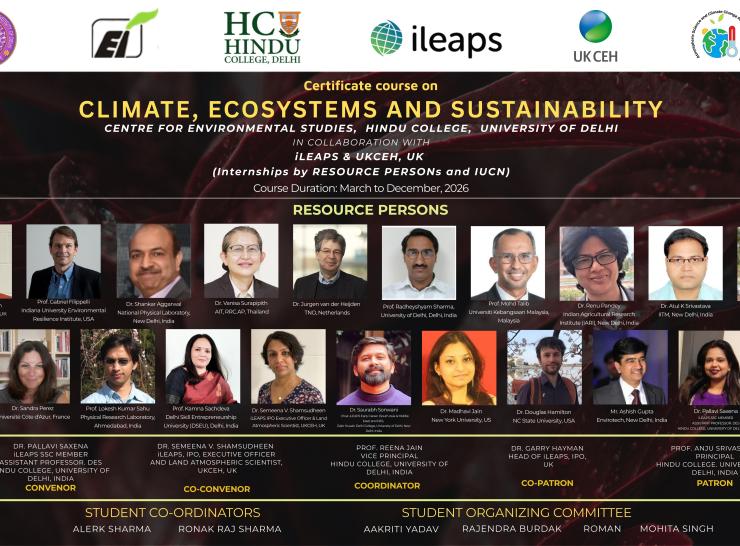
Certificate Course on “Climate, Ecosystems and Sustainability”
iLEAPS is co-organising a Certificate Course on “Climate, Ecosystems and Sustainability” at Hindu College, University of Delhi, organised in collaboration with iLEAPS, UK, explores the critical connections between climate change, ecosystems, and sustainable development. The program is supported by Envirotech Instruments Pvt. Ltd. and iLEAPS, UK.
This course provides students with an interdisciplinary understanding of the science of climate change, its impacts on natural ecosystems, and practical approaches to sustainability. Participants will examine how environmental systems respond to climate pressures and learn strategies that support long-term environmental resilience and sustainable development for both society and the planet.
The course features an excellent line-up of distinguished speakers and experts from academia and industry, who will share their knowledge and practical insights on climate science, ecosystems, and sustainability.
iLEAPS SSC co-chair nominations, 2026: Closed
We would like to inform the community that the deadline for iLEAPS co-chair nominations has been extended to 15th February 2026.
We strongly encourage nominations froma cross disciplines, regions, and career stages. Further details and nomination instructions are provided below. Please feel free to share this call within your networks.
We invite applications for new co-chair lead the Scientific Steering Committee. The SSC represents a broad spectrum of disciplines and nationalities, and includes scientists at different career stages. The success of iLEAPS relies on the input and leadership of SSC members. Funded by Future Earth, the SSC currently meets quarterly online and in person every two years. Scientists who serve on the SSC normally do so for a period of three years, with the potential of renewing for an additional three-year term.
iLEAPS promotes scientific excellence through developing international science collaborations that are multi-disciplinary, through bringing together the modelling community with satellite, experimental and field observational experts, and through enabling communication and networking across the international science community.
We collaborates with other global research networks within Future Earth: IGAC, AIMES, PAGES, SOLAS, the Global Carbon Project and the Mountain Research Initiative. iLEAPS has a scientific partnership with the Global Energy and Water Exchanges (GEWEX) project of the World Climate Research Programme (WCRP). Applicants should be familiar with the development of these organizations and be able to contribute positively to strengthening iLEAPS' position within this environment.
To apply
Please send the following items by email to Semeena V Shamsudheen, iLEAPS International Project Office – ipo@ileaps.org by 15 February 2026.
iLEAPS success story continues - Awarded Future Earth Cross-Cutting Funding for the Second Time: March 2025 Call
iLEAPS has once again secured the prestigious Future Earth Cross-Cutting Funding, in collaboration with the Mountain Research Initiative (MRI), Future Earth Asia, and the Sustainable Water Future Programme.
The project titled "A transdisciplinary approach to improve water resources prediction in complex mountain regions (Transdisciplinary Mountain Hydrology, TD-MH)", focuses on sustaining water security in rapidly changing mountain regions, combining advanced hydrological modeling, satellite and ground-based data, and stakeholder input. Through a co-production approach, it aims to deliver science that is both credible and actionable, supporting long-term water management solutions in vulnerable regions.
iLEAPS Awarded with the 2025 ESA-Future Earth Joint Programme Funding for case studies using Earth Observation in LMICs.
Led by the Indian Institute for Tropical Meteorology, Pune, this project—“Enhancing Urban Resilience and Air Quality Management in Delhi NCR through Integrated Earth Observation and Decision Support Systems”—aims to determine whether converting open wastelands into urban green spaces can reduce heat stress, improve air quality, and strengthen urban resilience. Using high-resolution Sentinel satellite data, machine-learning algorithms, and integration with AIRWISE and NSM_Urban models, the project will map wastelands across 19 NCR districts, assess dust emissions, and simulate greening scenarios. The outcomes will inform a Decision Support System (DSS) to help planners and policymakers identify priority areas for land conversion and guide evidence-based strategies for a more climate-resilient and sustainable Delhi–NCR.
Other partners of the project are Research Application Laboratory (RAL), National Center for Atmospheric Research (NCAR), Boulder, Colorado, USA. and the Department of Earth and Planetary Sciences, and Maseeh Department of Civil, Architectural and Environmental Engineering, The University of Texas at Austin, Austin.
iLEAPS Awarded Future Earth Cross-Cutting Initiative Funding, September 2024 Call
iLEAPS is pleased to announce its success in securing funding under the Future Earth Cross-Cutting Initiative (September 2024 call). The project is led by Middlesex University in collaboration with GreenFin Research Cluster academics and practitioners. Other Future Earth partners involved include the Finance & Economics Knowledge-Action Network (KAN) and the Water–Energy–Food Nexus Knowledge-Action Network (KAN).
This project will develop an end-to-end solution to improve farmers’ lives in Africa. To address the need for more equitable access to international markets, the project will utilise state-of-the-art satellite and supporting technology (e.g. drones, smartphones) to evidence improved farming practices, working with an initial sample of 400 cooperative farmers supported by the DAWN Commission in Western Nigeria. The trans-disciplinary expert project team will work with local farmers and support services on the ground to develop an effective blueprint (initially non-technical) proof-of-concept for developing a green blockchain end-to-end food production, transportation and export market solution – initially for the UK export market. This will collect data on farming practices, size, location, equipment usage and sharing, crop selection, crop performance, routes to market and financial performance, and co-create solutions with stakeholders.